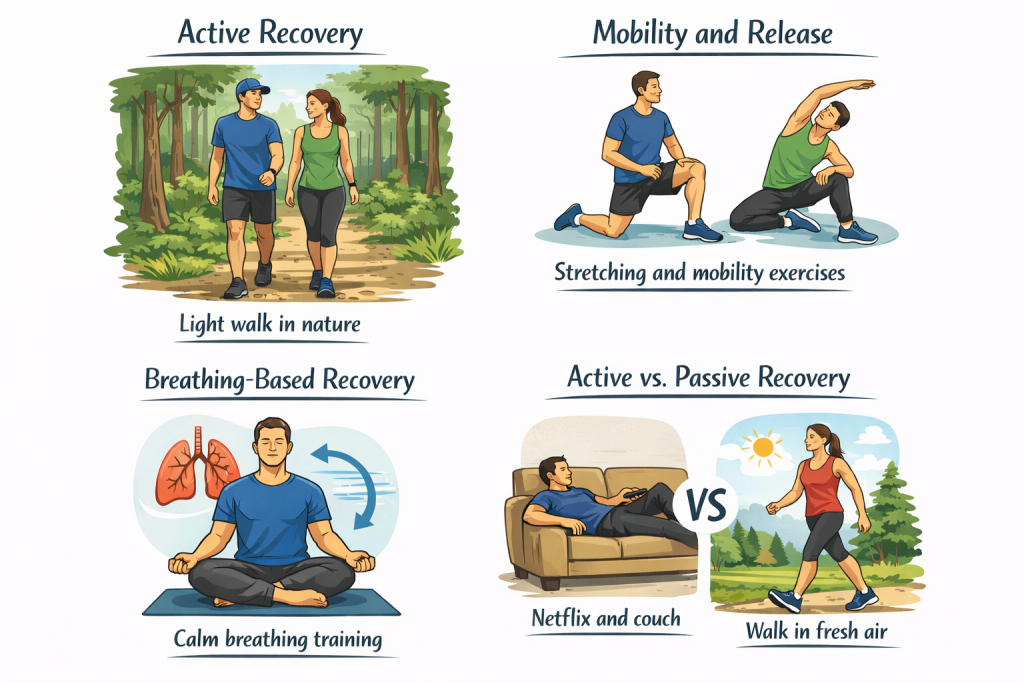
Most people understand recovery as rest = doing nothing. The couch, a TV series, Netflix, passive relaxation. That has its place – but if you want to improve performance, health, and mental well-being in the long term, you need to go one step further. This is where active recovery comes in.
Active recovery is not weakness and it is not a waste of time. On the contrary – it is a deliberate practice of recovery that allows you to train consistently, without unnecessary breaks or injuries.
Active recovery is light, controlled physical activity whose goal is not to improve fitness, but to speed up the body’s recovery after training or competition.
It typically involves:
The main difference from regular training? We don’t want to exhaust the body, but to gently activate and calm it.
Light movement:
Simply put: the body recovers faster through movement than through complete inactivity – as long as the movement is chosen correctly.
Lying on the couch and watching Netflix may feel pleasant in the short term, but from a recovery perspective it is often a worse option than a light walk. Blood circulation slows down, muscles stiffen, and the nervous system often remains in a stress state. Calm walking in nature – ideally in a forest – supports circulation, calms the mind, and signals to the body that it is safe to recover.
Passive recovery (sleep, lying down, sauna) is important – but on its own it is often not enough.
| Passive | Active |
|---|---|
| rest without movement | light, controlled movement |
| complete shutdown | stimulation of blood flow |
| suitable for extreme fatigue | ideal between training sessions |
The ideal strategy is a combination of both.
Active recovery can take many forms. It depends on the type of sport, the level of fatigue, and the mental state.
Intensity guideline: you should be able to speak in full sentences.
Goal: range of motion, fluidity, no pain.
Breathing is the fastest way to calm the nervous system and accelerate recovery.
Common among athletes – the body moves, but the mind stays calm.
A typical real-life example is active recovery after a Spartan Race. After finishing, most people tend to lie down, do nothing, and “rest.” In reality, it is far better to go for a light, calm walk, ideally in nature.
Light movement helps loosen stiff muscles, improves circulation, and speeds up the removal of residual fatigue. As a result, the body recovers faster than when you spend the entire day lying around waiting for soreness to pass.
If you feel pain, illness, or extreme exhaustion, skip active recovery and prioritize passive rest.
Nutrition is a frequently underestimated factor. If you include low-quality food on a rest day, the entire recovery process slows down. Instead of repairing muscles, calming the nervous system, and restoring hormonal balance, the body has to deal with inflammation, digestion, and internal imbalance.
The result is feeling tired even on rest days and recovery that does not work the way it should.
Remember: recovery is not weak training – it is a different objective.
People who stagnate or get injured repeatedly often do not train too little – they recover poorly or incorrectly.
If you want to:
then active recovery must have a solid place in your plan.
Active recovery:
Do not see it as a necessary evil. See it as an investment in future performance.
Vladimir Veverka
Personal trainer and nutrition consultant
Vladimír Veverka
Xplore Fitness
Na Příkopě 17/1047
Prague 1

Vladimír Veverka
Xplore Fitness
Na Příkopě 17/1047
Prague 1